Introduction
Industrial boilers play an essential role in generating steam for manufacturing, processing and power generation. However, selecting the right boiler depends on factors such as steam demand, operating pressure, fuel availability, efficiency and application requirements.
Two widely used industrial boiler types are fire tube boilers and water tube boilers. Although both generate steam by transferring heat from fuel combustion, their construction, heat transfer mechanisms, pressure capabilities and applications differ significantly.
Understanding the difference between a fire tube boiler vs water tube boiler helps industries select an appropriate steam generation system based on their operational requirements. Businesses exploring industrial steam generation can also learn more about Industrial Boiler Manufacturers in India and their engineered boiler solutions.
What Is a Fire Tube Boiler?
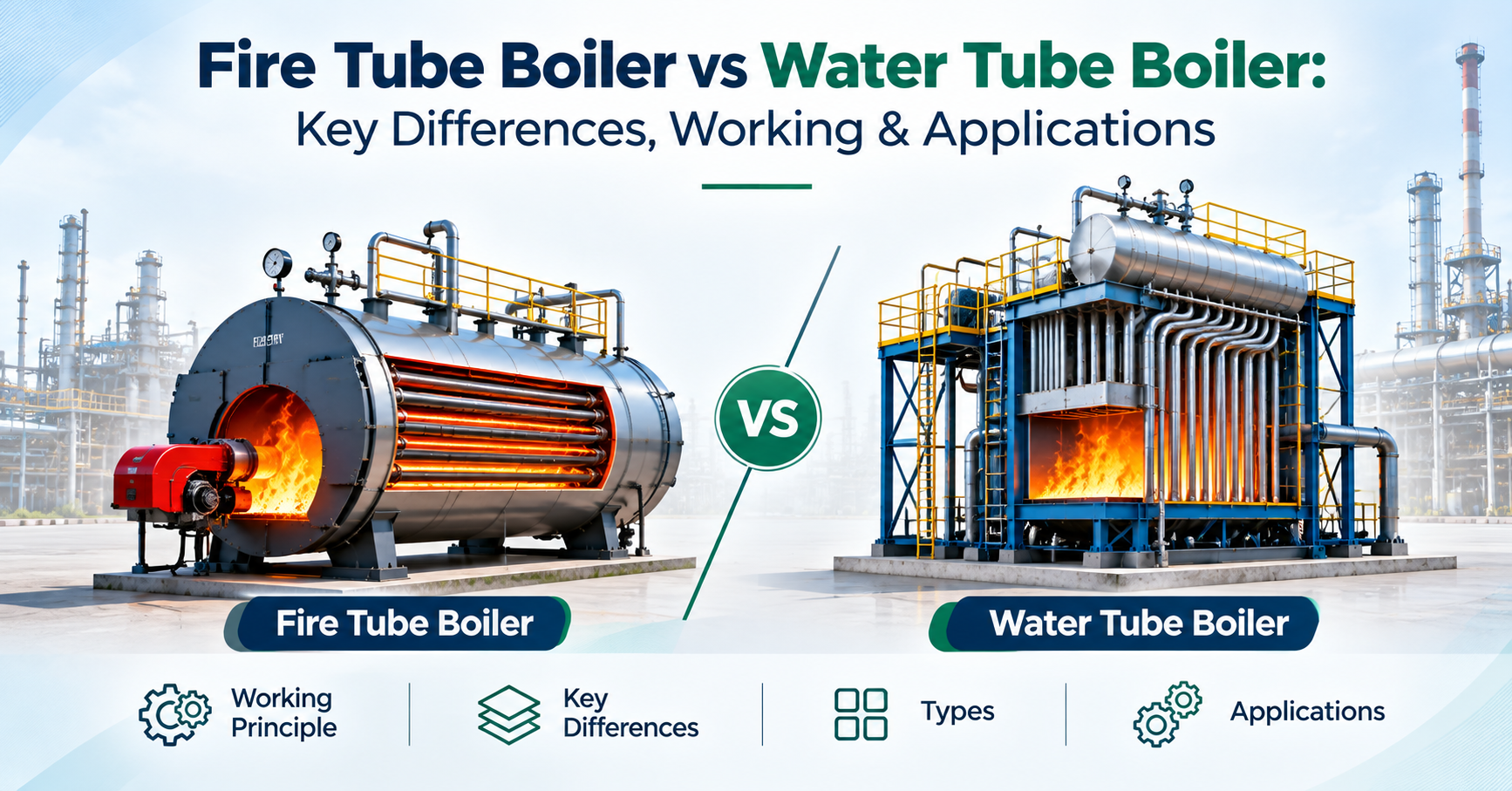
A fire tube boiler is a boiler in which hot combustion gases flow through tubes surrounded by water. Heat from these gases passes through the tube walls and transfers to the surrounding water, generating steam.
In this design, water is contained inside a large pressure vessel, while hot gases travel through multiple tubes. Fire tube boilers are commonly used in applications requiring moderate steam capacity and operating pressure.
How Does a Fire Tube Boiler Work?
The fire tube boiler working principle is based on heat transfer from hot gases to water.
Fuel combustion: Fuel burns inside the furnace, producing high-temperature combustion gases.
Gas circulation: Hot gases pass through tubes surrounded by water.
Heat transfer: Heat moves through the tube walls and raises the water temperature.
Steam generation: As the water reaches its boiling point, steam is produced.
Steam distribution: Generated steam collects in the upper section of the boiler and is supplied to the required process.
Fire tube boilers are generally valued for their relatively simple construction, straightforward operation and suitability for moderate steam requirements.
What Is a Water Tube Boiler?
A water tube boiler is a boiler in which water flows inside tubes while hot combustion gases circulate around their external surfaces. Heat from combustion transfers through the tube walls, converting water into steam.
Unlike fire tube boilers, water tube boilers use a network of tubes to carry water. This design supports higher operating pressures and large steam generation capacities, making them suitable for demanding industrial applications.
How Does a Water Tube Boiler Work?
The water tube boiler working principle involves circulating water through heated tubes.
Water circulation: Feedwater enters the boiler and circulates through the designated water tubes.
Fuel combustion: Fuel burns in the furnace, generating high-temperature gases.
Heat transfer: Hot gases flow around the water-filled tubes, transferring heat to the water.
Steam formation: Water absorbs heat and changes into steam.
Steam separation: The generated steam is separated from water, typically through a steam drum in drum-type designs.
Steam supply: Steam is delivered to industrial processes or power generation systems.
Water tube boilers are commonly selected for high-pressure, high-capacity steam generation requirements.
Fire Tube Boiler vs Water Tube Boiler: Key Differences
The main difference between these boilers is the medium flowing inside the tubes. In a fire tube boiler, hot gases pass through the tubes, whereas in a water tube boiler, water flows through the tubes.
Comparison Factor | Fire Tube Boiler | Water Tube Boiler |
Working principle | Hot gases flow inside tubes | Water flows inside tubes |
Water location | Surrounds the tubes | Flows through the tubes |
Gas location | Passes through the tubes | Flows around the tubes |
Operating pressure | Generally suitable for low-to-moderate pressure | Suitable for higher-pressure applications |
Steam capacity | Generally moderate | Suitable for high steam capacity |
Steam generation | Comparatively slower for large demand | Generally faster response to high steam demand |
Construction | Relatively simple | More complex tube arrangement |
Water content | Generally higher | Generally lower |
Maintenance | Relatively straightforward | Requires specialised inspection and maintenance |
Applications | Small and medium industrial processes | Large industrial facilities and power generation |
Note: Actual pressure, capacity, efficiency and performance depend on boiler design, configuration, fuel and operating conditions.
Advantages and Disadvantages of Fire Tube and Water Tube Boilers
Both boiler types offer specific advantages depending on the application.
Advantages of Fire Tube Boilers
Simple construction: Their design is comparatively straightforward, making operation and maintenance easier.
Lower initial complexity: They generally require less complicated construction than large water tube systems.
Suitable for moderate steam demand: They work well in facilities that do not require extremely high steam output.
Operational convenience: Their relatively simple design can make routine operation easier.
Disadvantages of Fire Tube Boilers
Limited suitability for very high-pressure applications.
Generally less suitable for extremely large steam generation requirements.
Higher water content can result in slower response to changing steam demand.
Large pressure vessels require appropriate safety and inspection procedures.
Advantages of Water Tube Boilers
High-pressure operation: Their construction supports demanding steam pressure requirements.
High steam generation capacity: Suitable for large industrial facilities and power generation.
Faster steam generation: Lower water content can support quicker response to changing operating conditions.
Scalable configurations: Different tube arrangements can be designed for specific industrial requirements.
Disadvantages of Water Tube Boilers
More complex construction and installation.
Requires skilled operators and specialised maintenance.
Water quality must be carefully controlled to prevent scaling and tube damage.
Initial investment can be higher depending on capacity and configuration.
Industrial Applications of Fire Tube and Water Tube Boilers
The choice between fire tube and water tube boilers depends on the steam requirements, operating conditions and nature of industrial processes.
Fire Tube Boiler Applications
Fire tube boilers are commonly used in:
Food processing: Steam generation for cooking, cleaning and processing operations.
Textile industries: Heating, dyeing and fabric processing.
Hotels and hospitals: Hot water and steam requirements for laundry, sterilisation and utility services.
Small manufacturing units: Process heating and general industrial steam requirements.
Chemical processing: Applications involving moderate steam pressure and capacity.
Water Tube Boiler Applications
Water tube boilers are commonly used in:
Power generation: Producing high-pressure steam for steam turbines.
Large manufacturing plants: Supporting continuous and high-volume steam requirements.
Petrochemical industries: Providing process steam for demanding industrial operations.
Steel and metal industries: Supplying steam and heat for industrial processes.
Sugar and paper industries: Supporting large-scale production and process heating.
For facilities evaluating integrated steam and process heating requirements, Boilers & Process Heating Equipment can provide a useful starting point for understanding available industrial solutions.
Which Boiler Should You Choose?
Choosing between a fire tube boiler and a water tube boiler requires evaluating the specific requirements of your facility. Neither design is universally better; the right option depends on operating conditions.
Consider these factors before making a decision:
Steam demand: Estimate the total steam required during normal and peak production.
Operating pressure: Identify the pressure required by your industrial process.
Fuel availability: Evaluate the availability, cost and suitability of fuels such as coal, biomass, oil or gas.
Space availability: Consider the installation area and supporting infrastructure.
Operating costs: Compare fuel consumption, maintenance requirements and overall lifecycle costs.
Water quality: Assess the water treatment facilities required for reliable boiler operation.
Future expansion: Select a system that can accommodate potential increases in production capacity.
Boiler efficiency should also be considered when evaluating long-term operating costs. Regular maintenance, combustion control, insulation and heat recovery can improve overall system performance. Explore these industrial boiler efficiency improvement practices when assessing energy optimisation opportunities.
When comparing different boiler configurations, it is important to work with experienced boiler manufacturers in India who can assess steam requirements, operating pressure, fuel options and plant-specific requirements before recommending a suitable industrial boiler system.
Conclusion
Understanding the differences between a fire tube boiler vs water tube boiler is essential for selecting the right industrial steam generation system. Fire tube boilers are generally suitable for moderate steam requirements and relatively simple operations, while water tube boilers are preferred for higher-pressure and larger-capacity applications.
Before selecting a boiler, industries should evaluate steam demand, operating pressure, fuel availability, efficiency, installation requirements and long-term maintenance costs. Working with an experienced industrial boiler engineering company can help ensure the system meets both present and future operational needs.
DAACK Vessels provides industrial boiler and process heating solutions designed around industrial requirements. Businesses looking for reliable engineering support can explore its range of industrial boiler solutions to understand the available options.

Frequently Asked Questions
1. What is the main difference between a fire tube boiler and a water tube boiler?
The main difference is the flow arrangement. In a fire tube boiler, hot gases pass through tubes surrounded by water. In a water tube boiler, water flows inside tubes while hot gases pass around them.
2. Which is more efficient, a fire tube or water tube boiler?
Neither type is automatically more efficient. Efficiency depends on boiler design, combustion system, fuel quality, operating conditions, maintenance and heat recovery arrangements.
3. Which boiler is suitable for high-pressure applications?
Water tube boilers are generally preferred for high-pressure applications because their construction is better suited to higher operating pressures and large steam capacities.
4. What industries use fire tube boilers?
Fire tube boilers are commonly used in food processing, textile manufacturing, hotels, hospitals and small-to-medium manufacturing facilities requiring moderate steam output.
5. What industries use water tube boilers?
Water tube boilers are commonly used in power generation, petrochemicals, steel manufacturing, sugar production, paper manufacturing and other industries requiring high-pressure or high-capacity steam.