
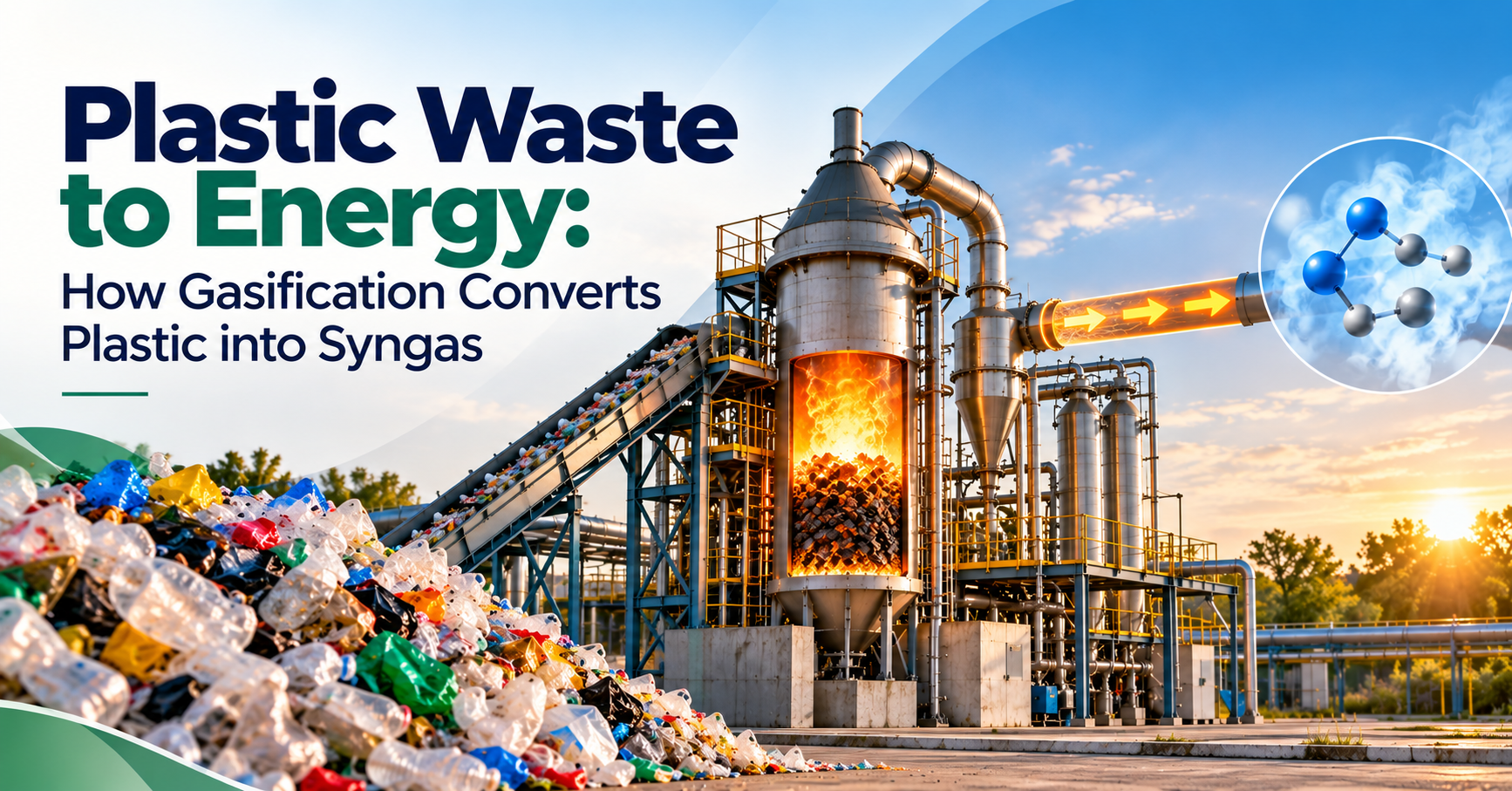
Plastic waste is a growing waste-management challenge, particularly when certain plastic streams are difficult or unsuitable to recycle economically. Plastic waste to energy technologies offer an alternative approach by converting suitable non-recyclable plastic waste into useful energy products.
One such technology is plastic waste gasification. Instead of simply disposing of plastic waste, gasification uses a controlled high-temperature process with a limited supply of oxygen or another gasifying medium to convert suitable carbon-containing feedstock into a combustible gas known as syngas.
But how does plastic gasification work, what is syngas, and how can plastic waste be converted into energy?
What Is Plastic Waste Gasification?
Plastic waste gasification is a thermochemical process that converts suitable plastic waste into a gas mixture containing primarily carbon monoxide and hydrogen, along with other gases depending on the feedstock and process conditions.
The resulting gas is commonly referred to as syngas, or synthesis gas.
In a typical plastic waste to energy system, the process can be broadly represented as:
Plastic waste → Feedstock preparation → Gasification → Syngas → Gas cleaning/conditioning → Energy application
The exact process configuration depends on the type and composition of plastic waste, plant design, operating conditions and the intended use of the syngas.
DAACK Vessels provides engineered Plastic Gasification Plants designed for suitable non-recyclable plastic waste and industrial energy applications.
How Does Plastic Gasification Work?
The plastic gasification process takes place through a sequence of thermochemical reactions.
1. Feedstock Preparation
The first stage is preparing the plastic waste for the gasification system.
Depending on the feedstock, preparation may involve:
Sorting
Removal of unsuitable materials
Size reduction
Shredding
Moisture management
Feedstock homogenization
Consistent feedstock characteristics can help the gasification system operate more predictably.
Not every plastic waste stream is automatically suitable for gasification. Feedstock composition and contamination need to be assessed during project development.
2. Feeding the Plastic Waste
Prepared material is introduced into the gasification system under controlled operating conditions.
The feed system needs to provide a consistent flow of feedstock to maintain stable operation.
3. Thermochemical Conversion
Inside the gasifier, the plastic undergoes thermal decomposition and conversion reactions at elevated temperatures in a controlled environment.
Unlike conventional combustion, gasification operates with a controlled amount of oxygen or gasifying medium rather than excess oxygen for complete combustion.
The carbon-containing material is converted into gaseous products, including components that contribute to syngas formation.
4. Syngas Generation
The main product of the gasification process is syngas from plastic waste.
Syngas can contain:
Hydrogen
Carbon monoxide
Carbon dioxide
Methane
Other gases and trace compounds
Its exact composition depends on the plastic feedstock, gasification technology, temperature, gasifying medium and operating conditions.
How Does Gasification Convert Plastic into Syngas?
The conversion of plastic to syngas occurs through thermochemical reactions that break down the polymeric material and convert its carbon and hydrogen content into gaseous compounds.
In simplified terms:
Plastic waste + controlled gasification conditions → Syngas + solid residues + other process products
The gasification process does not simply melt plastic and turn it directly into a single gas. Instead, complex thermal decomposition and gas-phase reactions take place within the gasifier.
The resulting gas then requires appropriate cleaning and conditioning before being used for a specific energy or industrial application.
How Is Plastic Waste Converted into Energy?
The objective of plastic waste to energy conversion is to recover useful energy from suitable plastic waste that may otherwise require disposal or have limited recycling options.
After gasification, the syngas can potentially be used as an energy-bearing gas depending on its composition and the overall system design.
Potential applications can include:
Industrial heating
Process-energy applications
Boiler fuel applications
Gas engines or other power-generation systems where technically appropriate
Combined heat and power applications
The appropriate application depends on syngas quality, gas-cleaning requirements, energy demand and project economics.
This makes gasification particularly relevant to industrial facilities looking for integrated waste-to-energy gasification solutions.
What Is a Plastic Gasification Plant?
A plastic gasification plant is an integrated system designed to receive suitable plastic waste, convert it through gasification and process the resulting syngas for an intended application.
A typical system may include:
Feedstock preparation
Plastic feeding system
Gasifier
Syngas cooling or conditioning
Gas cleaning
Syngas handling
Energy-utilization equipment
Residue handling
Monitoring and control systems
The exact configuration depends on feedstock characteristics, capacity, operating conditions and the required end use.
For industrial applications, DAACK Vessels' containerised plastic gasification plants provide a technology route for suitable non-recyclable plastic waste and syngas generation.
What Types of Plastic Waste Can Be Used?
The suitability of plastic waste depends on its physical and chemical characteristics.
Potentially relevant feedstocks can include suitable non-recyclable plastic streams that meet the gasification system's design requirements.
However, plastic waste should not be assumed to be universally suitable.
Factors that need to be assessed include:
Polymer composition
Moisture content
Contamination
Inert materials
Chlorine or other problematic elements
Particle size
Feedstock consistency
Heating value
Feedstock characterization is therefore an important part of designing a plastic waste gasification plant.
Plastic Waste Gasification vs Conventional Plastic Disposal
Traditional disposal methods may not recover the energy contained in plastic waste.
Gasification provides a different pathway by converting suitable waste into a gaseous energy carrier.
The comparison can be summarized as:
Approach | Primary Objective |
Mechanical recycling | Recover material for reuse |
Landfilling | Dispose of waste |
Conventional combustion | Recover heat through combustion |
Gasification | Convert suitable carbonaceous waste into syngas |
Gasification should not be viewed as a replacement for recycling where high-quality recycling is technically and economically viable. Instead, it can provide an additional route for suitable non-recyclable plastic waste.
Benefits of Plastic Waste to Energy Gasification
Waste Diversion
Gasification can provide an alternative pathway for suitable plastic waste that is difficult or unsuitable to recycle.
Energy Recovery
The process can recover energy from the carbon content of suitable plastic waste through syngas production.
Syngas Production
The generated syngas can potentially serve as an energy carrier for suitable industrial applications after appropriate cleaning and conditioning.
Industrial Integration
Plastic gasification can be integrated into industrial energy systems where waste availability and energy demand are compatible.
Reduced Dependence on Disposal
By converting suitable waste into useful energy products, gasification can contribute to a broader resource-recovery strategy.
What Happens to Syngas After Gasification?
Producing syngas is only one part of a plastic gasification system.
The gas may contain particulates, condensable compounds and other contaminants depending on the feedstock and gasification process.
Therefore, syngas generally needs to undergo appropriate cooling, cleaning and conditioning before being directed to its intended application.
The required treatment depends on:
Gas composition
End-use equipment
Emission requirements
Process conditions
Feedstock characteristics
The overall system should therefore be designed around both the gasification stage and the final energy application.
Is Plastic Gasification a Waste-to-Energy Technology?
Yes. Plastic gasification can be considered a waste-to-energy pathway when suitable plastic waste is converted into an energy-bearing syngas that is subsequently used for useful energy generation or industrial applications.
However, whether a particular project is technically and economically viable depends on the feedstock, plant capacity, syngas utilization route, emissions controls, energy demand and regulatory requirements.
This is why project-specific engineering and feedstock assessment are essential before selecting a gasification system.
Plastic Gasification for Industrial Energy Applications
Industrial facilities that generate or have access to suitable plastic waste may evaluate gasification as part of an integrated energy strategy.
The strongest applications are those where three factors align:
Suitable waste feedstock + reliable energy demand + technically appropriate syngas utilization
For example, a facility with a consistent supply of suitable non-recyclable plastic waste and a significant requirement for process energy may evaluate a gasification-based system as part of its broader energy infrastructure.
DAACK Vessels also works across industrial energy technologies, including Process Heat & Power Solutions, allowing waste-to-energy technologies to be considered alongside broader industrial energy requirements.
Conclusion
Plastic waste to energy through gasification provides a potential route for recovering useful energy from suitable non-recyclable plastic waste.
The process begins with feedstock preparation and controlled gasification, followed by syngas generation, cleaning and conditioning. Depending on its composition and the overall system design, the resulting syngas can be used for suitable industrial heating or power-generation applications.
However, successful plastic waste gasification depends on more than the gasifier itself. Feedstock quality, plant configuration, syngas cleaning, energy utilization, emissions management and project-specific engineering all need to be evaluated together.
For industries exploring plastic waste processing and energy recovery, learn more about DAACK Vessels' Plastic Gasification Plants and its approach to converting suitable non-recyclable plastic waste into syngas for industrial energy applications.

Frequently Asked Questions
Can plastic waste be converted into energy?
Yes. Suitable non-recyclable plastic waste can be processed through technologies such as gasification to produce syngas, which can potentially be used for industrial heat or power applications after appropriate gas cleaning and conditioning.
How does plastic waste gasification work?
Plastic waste is prepared and fed into a gasifier, where controlled high-temperature thermochemical reactions convert the carbon-containing material into syngas and other process products.
What is produced from plastic gasification?
The primary gaseous product is syngas, which can contain hydrogen, carbon monoxide, carbon dioxide, methane and other gases. Solid residues and other process products may also be generated.
What is syngas from plastic waste?
Syngas from plastic waste is a combustible gas mixture generated by gasifying suitable plastic feedstock under controlled thermochemical conditions.
What is the difference between plastic recycling and gasification?
Recycling aims to recover plastic material for reuse, while gasification converts suitable plastic waste into syngas for potential energy or industrial applications. Gasification can therefore be considered for waste streams that are unsuitable or difficult to recycle.
What is a plastic gasification plant?
A plastic gasification plant is an integrated facility containing equipment for plastic feedstock preparation, gasification, syngas cleaning and conditioning, gas handling and the intended energy-utilization system.