
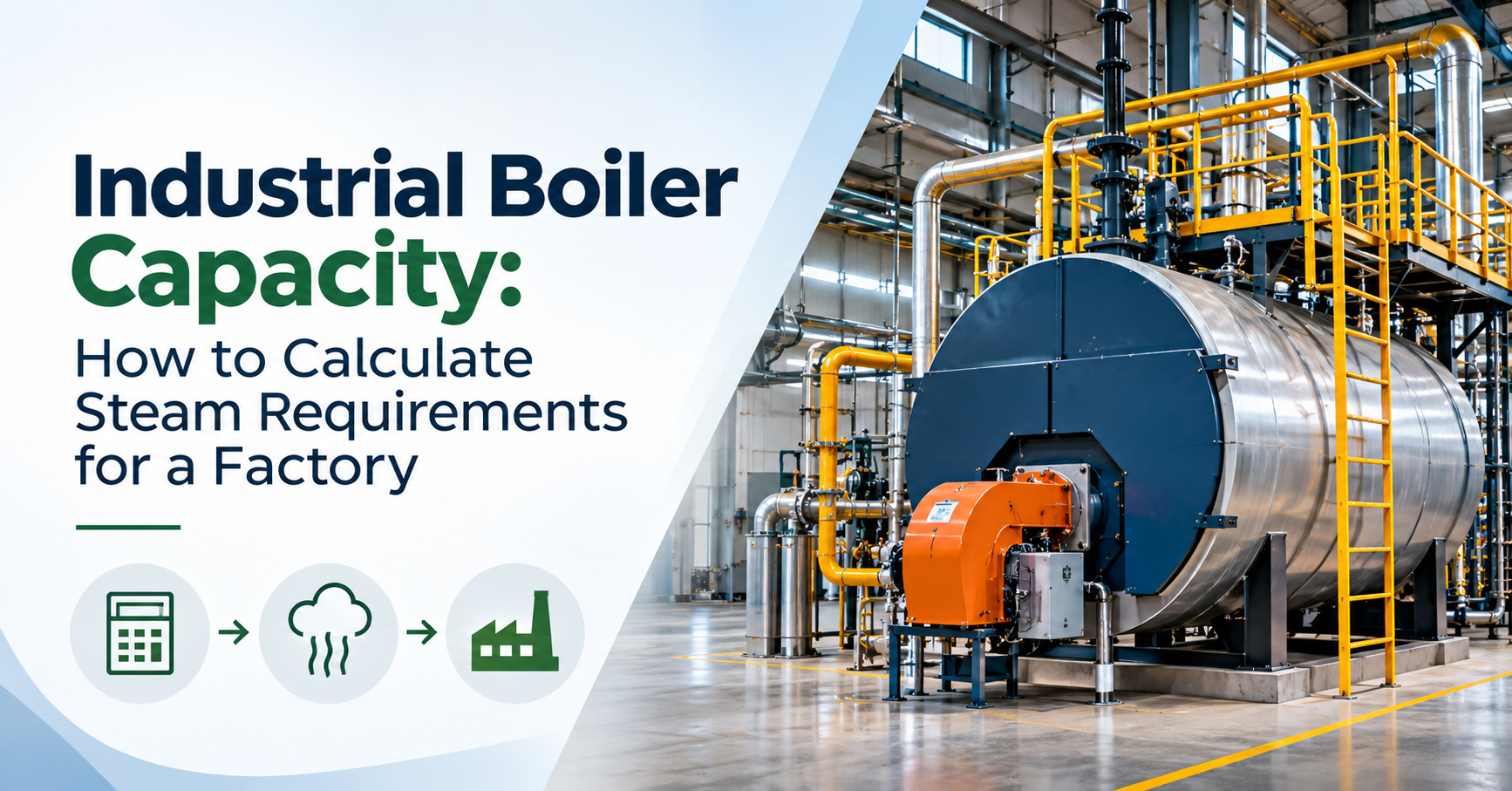
Selecting the right industrial boiler capacity is essential for maintaining reliable steam supply, efficient plant operation and consistent production. A boiler that is too small may struggle to meet peak steam demand, causing pressure drops and production delays. An oversized boiler can result in unnecessary capital expenditure and inefficient operation at low loads.
So, how do you calculate the right boiler capacity for a factory?
The basic approach is to determine the factory's normal, peak and simultaneous steam demand, account for relevant system requirements and then select a boiler capacity that can reliably meet the required load.
For factories evaluating complete thermal-energy requirements, DAACK Vessels provides Industrial Boilers and engineered process-energy solutions for industrial applications.
What Is Industrial Boiler Capacity?
Industrial boiler capacity refers to the amount of steam a boiler can generate over a specified period, commonly expressed in kg/hr or tonnes per hour (TPH).
For example:
1 TPH = 1,000 kg/hr
2 TPH = 2,000 kg/hr
5 TPH = 5,000 kg/hr
However, steam output alone does not define the complete boiler requirement. The required steam pressure, steam condition, feedwater conditions, operating pattern and process demand must also be considered when selecting an industrial steam boiler.
This is why boiler capacity selection should begin with the factory's actual process requirements rather than simply selecting equipment based on factory size or production area.
Why Accurate Boiler Capacity Calculation Matters
The boiler must produce sufficient steam when the factory reaches its realistic peak demand. If the selected capacity is inadequate, steam pressure may fall when multiple production processes operate simultaneously.
An oversized boiler is not automatically a better choice. If it operates significantly below its rated capacity for extended periods, the overall system may not operate as efficiently as intended.
Accurate boiler capacity calculation therefore starts with the factory's actual steam load.
For facilities that require integrated thermal and electrical energy solutions, explore DAACK Vessels' Process Heat & Power Solutions.
How to Calculate Steam Requirements for a Factory
The following process can be used as a preliminary framework for calculating steam requirements for a factory.
1. List All Steam-Consuming Equipment
Start by preparing an inventory of every process and machine that consumes steam.
Depending on the industry, this may include:
Heat exchangers
Dryers
Jacketed vessels
Reactors
Autoclaves
Sterilizers
Textile processing machines
Evaporators
Steam presses
Process heaters
Cleaning systems
For each steam-consuming unit, record its steam consumption in kg/hr, required pressure, operating duration and production cycle.
Where possible, use equipment datasheets, process calculations or measured plant data rather than assumptions.
2. Determine Normal and Peak Steam Demand
Not every piece of equipment operates at maximum steam consumption at the same time.
This is one of the most important considerations in industrial boiler sizing.
Separate the factory load into:
Minimum steam demand
Normal operating demand
Maximum realistic demand
Startup or warm-up demand
Batch-process demand
Intermittent utility demand
Confirmed future demand
The boiler should be sized around the maximum realistic simultaneous demand, rather than simply adding every connected equipment rating.
3. Calculate Simultaneous Steam Demand
A basic steam demand calculation can be expressed as:
Peak Steam Demand = Sum of Steam Consumption of Equipment Operating Simultaneously
For example, suppose a factory has:
Steam User | Steam Consumption |
Process heater | 500 kg/hr |
Dryer | 400 kg/hr |
Jacketed vessel | 250 kg/hr |
Heat exchanger | 300 kg/hr |
If all four units can operate simultaneously:
Peak steam demand = 500 + 400 + 250 + 300
Peak steam demand = 1,450 kg/hr
Therefore, the preliminary process requirement is approximately 1.45 TPH.
Boiler Capacity Calculation Formula
A simplified preliminary formula is:
Required Boiler Capacity = Peak Simultaneous Steam Demand + Applicable System Allowances
For example:
Peak simultaneous demand = 1,450 kg/hr
Assume a justified 10% planning allowance:
1,450 × 1.10 = 1,595 kg/hr
The preliminary requirement is therefore approximately 1,595 kg/hr, or 1.6 TPH.
The final boiler selection should then consider available standard capacities, operating range, pressure requirements, redundancy, startup conditions and future confirmed demand.
The allowance should be based on actual engineering requirements rather than adding an unnecessarily large safety factor.
4. Consider Required Steam Pressure
Steam capacity and steam pressure must be considered together.
A factory may require different pressures for different processes. The boiler must be capable of supplying the required pressure while accounting for pressure losses through the steam distribution system.
When calculating boiler requirements, consider:
Required process pressure
Boiler operating pressure
Steam-main pressure drop
Control-valve losses
Pressure-reducing stations
Steam quality requirements
Distance between boiler and process equipment
If a process requires a specific pressure at the point of use, the boiler-house pressure cannot be selected without considering the distribution system.
5. Account for Startup and Peak Loads
A factory's steady-state steam requirement may differ considerably from its startup requirement.
During startup, steam may be required to heat:
Process vessels
Piping
Heat exchangers
Product or process fluids
Dryers
Storage equipment
Batch-processing plants can experience short-duration peaks when several processes start together.
Therefore, boiler sizing calculation should consider normal operation as well as realistic startup and peak conditions.
6. Consider Feedwater and Condensate Return
The condition of the water entering the boiler also affects the overall steam-generation system.
Important parameters include:
Feedwater temperature
Condensate return percentage
Condensate temperature
Makeup-water requirement
Blowdown
Water-treatment conditions
A plant with substantial hot condensate return may have different energy requirements from one using predominantly cold makeup water.
Boiler capacity should therefore be evaluated as part of the complete steam system rather than as an isolated equipment rating.
Worked Example: Industrial Boiler Capacity for a Factory
Consider a manufacturing facility with the following estimated simultaneous steam requirements:
Process | Steam Demand |
Process heater | 600 kg/hr |
Dryer | 450 kg/hr |
Jacketed vessel | 300 kg/hr |
Heat exchanger | 250 kg/hr |
Total simultaneous steam demand:
600 + 450 + 300 + 250 = 1,600 kg/hr
Now assume the engineering assessment identifies a justified 10% allowance:
1,600 × 1.10 = 1,760 kg/hr
The preliminary boiler requirement is therefore approximately:
1,760 kg/hr = 1.76 TPH
The final boiler selection would then consider the required operating pressure, fuel, minimum operating load, startup characteristics, feedwater conditions, emissions requirements and future expansion.
This demonstrates why the answer to “how much boiler capacity is required for a factory?” cannot be determined from factory floor area alone. The process steam load is the more meaningful starting point.
Factors That Affect Industrial Boiler Sizing
Several factors can influence the final industrial boiler capacity.
Production Capacity
Higher production output may increase steam demand, particularly where steam consumption is directly linked to production volume.
Process Type
Drying, heating, sterilization, cooking, evaporation and chemical processing can have substantially different steam requirements.
Operating Schedule
A factory running continuously may have a different load profile from a batch-processing facility.
Peak Demand
The highest realistic simultaneous demand is important when determining boiler capacity.
Steam Pressure
The required process pressure affects boiler and steam-system design.
Startup Load
Short-duration startup requirements can influence the required boiler configuration.
Condensate Return
Higher condensate return can affect the overall energy balance of the steam system.
Future Expansion
Confirmed production expansion should be considered without unnecessarily oversizing the boiler for speculative demand.
How Boiler Efficiency Affects Capacity Planning
Capacity and efficiency should be evaluated together.
A boiler may have sufficient rated steam output but still have higher operating costs if the system is inefficient. Factors such as combustion efficiency, heat losses, blowdown, feedwater temperature and steam distribution can affect overall performance.
For practical ways to improve plant performance, see our guide on Industrial Boiler Efficiency: How to Reduce Fuel Consumption in a Factory.
Where industrial processes generate usable waste heat, a Waste Heat Recovery Boiler can also be evaluated as part of an integrated energy strategy.
Steam Generation and Power Generation
Some industrial plants use steam not only for process heating but also for power generation.
Where the steam system has suitable pressure and flow conditions, steam turbines can potentially be integrated into the overall energy system.
DAACK Vessels provides Packaging Steam Turbines for industrial applications involving steam-based power generation.
For plants evaluating turbine configurations, our guide Back Pressure vs Condensing Steam Turbine explains the key differences between the two approaches.
Industrial facilities can also explore Incidental Power Generation Using Back Pressure Steam Turbines where process steam conditions make power recovery practical.
Common Boiler Capacity Calculation Mistakes
Adding Every Equipment Rating
Adding the maximum steam consumption of every machine can significantly overstate the actual simultaneous load.
Using Factory Area as the Main Calculation
Factory size does not directly determine process steam consumption.
Ignoring Pressure Requirements
A boiler with adequate TPH capacity may still fail to satisfy the process if the required steam pressure is not properly considered.
Oversizing Without Engineering Basis
Adding a very large safety margin can result in unnecessary capital expenditure and inefficient operation.
Ignoring Startup Demand
Batch and thermal processes may have substantially higher short-term demand during startup.
Failing to Consider Future Expansion
If a confirmed production expansion is planned, the boiler system should be evaluated for that additional demand during the design stage.
How to Choose the Right Industrial Boiler Capacity
A practical industrial boiler sizing process involves the following steps:
Identify All Steam Users
List every machine, process and equipment that requires steam in the factory.Record Steam Consumption
Determine the steam consumption of each equipment or process in kg/hr or TPH.Establish Normal and Peak Loads
Identify the factory's average operating demand and maximum realistic steam demand.Determine Simultaneous Steam Demand
Calculate how much steam is required when multiple processes operate at the same time.Evaluate Startup Requirements
Consider additional steam required during plant startup, warm-up and batch-process operations.Confirm Required Steam Pressure
Determine the pressure required at each process and account for pressure losses through the steam distribution system.Evaluate System Losses
Consider relevant steam losses, distribution losses and other system requirements when determining the final capacity.Consider Feedwater and Condensate
Evaluate feedwater temperature, condensate return, makeup water and blowdown requirements.Assess Future Expansion
Consider confirmed production expansion and future steam demand without unnecessarily oversizing the boiler.Select the Appropriate Boiler Configuration
Choose the boiler capacity and configuration based on the calculated steam demand, operating conditions, fuel requirements and plant requirements.
The final boiler capacity selection should be based on verified process and site data and reviewed by qualified boiler and process engineers.
For a broader view of industrial thermal-energy requirements, explore DAACK Vessels' Boilers & Process Heating Equipment
Conclusion
Correct industrial boiler capacity calculation starts with the factory's actual steam demand—not an arbitrary boiler size.
By identifying individual steam users, calculating simultaneous demand, evaluating peak and startup loads, confirming pressure requirements and considering relevant system conditions, factories can establish a more reliable basis for boiler selection.
For a new plant, expansion or boiler replacement, a detailed process load assessment should be completed before final equipment selection. This helps balance steam availability, operational reliability and energy performance while avoiding unnecessary oversizing.
For industrial facilities looking for engineered boiler and process-energy solutions, visit DAACK Vessels' Industrial Boiler Manufacturers in India.
Frequently Asked Questions
How do you calculate industrial boiler capacity?
Industrial boiler capacity is calculated by determining the factory's maximum realistic simultaneous steam demand and evaluating applicable system requirements, startup demand, operating allowance and confirmed future demand.
What is the formula for calculating boiler capacity?
A preliminary formula is:
Required Boiler Capacity = Peak Simultaneous Steam Demand + Applicable System Allowances
The final engineering calculation depends on pressure, steam conditions, feedwater, condensate return, startup load and other plant-specific parameters.
How do you calculate steam requirements for a factory?
List all steam-consuming equipment, obtain their steam consumption, determine which loads operate simultaneously, calculate the peak realistic demand and evaluate relevant system requirements.
How much steam does a factory need?
There is no single steam requirement for every factory. Demand depends on the production process, equipment, production rate, operating schedule, pressure and thermal duty.
How is steam boiler capacity selected?
Steam boiler capacity is selected by matching the boiler's rated steam output and operating conditions to the factory's realistic load profile, including normal, peak and startup requirements.
What factors determine boiler capacity?
Key factors include steam demand, simultaneous load, operating pressure, startup demand, process requirements, feedwater conditions, condensate return, system losses, fuel and confirmed future expansion.