
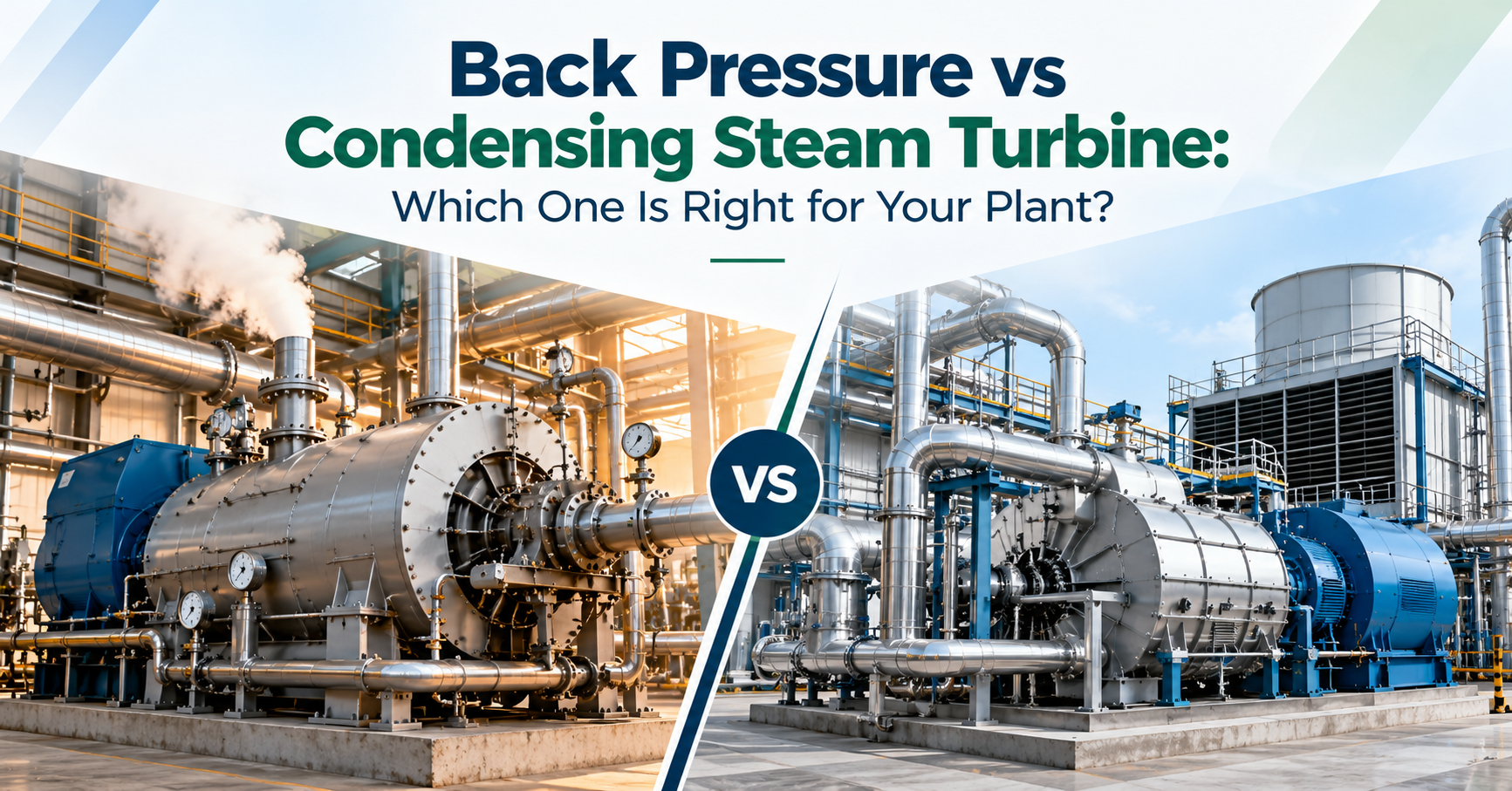
Choosing the right steam turbine configuration is an important decision for industries that use high-pressure steam for power generation and process applications. Two of the most common configurations are back pressure steam turbines and condensing steam turbines.
Although both turbines convert steam energy into mechanical power, they operate differently and are designed for different plant requirements. Understanding the difference between a back pressure steam turbine and a condensing steam turbine can help plant engineers select the right system based on steam demand, pressure requirements, power generation goals and overall plant efficiency.
So, which is better: a back pressure or condensing steam turbine? The answer depends on how your plant uses steam.
What Is a Back Pressure Steam Turbine?
A back pressure steam turbine is designed to expand high-pressure steam and generate power while discharging the exhaust steam at a pressure that can still be used by downstream industrial processes.
Instead of condensing the exhaust steam into water, the turbine sends it to equipment that requires steam at a lower pressure.
For example, a manufacturing facility may receive high-pressure steam from a boiler. The steam passes through a back pressure turbine, producing electricity or mechanical power. The exhaust steam can then be supplied to processes such as heating, drying, evaporation or other thermal applications.
This makes a back pressure turbine particularly suitable for facilities where electricity generation and process steam are both required.
For factories looking to integrate steam generation, process heating and power generation, working with experienced Industrial Boiler Manufacturers in India can help in evaluating the complete steam and energy system.
What Is a Condensing Steam Turbine?
A condensing steam turbine expands steam to a much lower exhaust pressure, generally using a condenser to convert the exhaust steam back into water.
The turbine is designed to extract as much energy as practical from the steam before it reaches the condenser. Because the exhaust pressure can be significantly lower than atmospheric pressure, the turbine can generate more power from a given quantity of steam under suitable operating conditions.
Condensing turbines are commonly considered when power generation is the primary objective and there is limited or no requirement to use the turbine exhaust steam directly in an industrial process.
Back Pressure vs Condensing Steam Turbine: Key Differences
The main difference between these turbine configurations is what happens to the steam after it passes through the turbine.
| Factor | Back Pressure Steam Turbine | Condensing Steam Turbine |
| Exhaust pressure | Above or around required process pressure | Very low pressure |
| Exhaust steam | Used for industrial processes | Condensed in a condenser |
| Main objective | Power + useful process steam | Maximum power generation |
| Process steam requirement | Important | Usually not essential |
| Condenser | Generally not required | Required |
| Typical application | Combined heat and power/process industries | Power generation |
| System complexity | Generally lower | Generally higher |
| Best suited for | Plants with continuous steam demand | Plants focused on electricity generation |
Therefore, selecting between a back pressure turbine vs condensing turbine should begin with the plant’s steam requirements rather than simply comparing turbine specifications.
For plants evaluating both configurations, Daack Vessels provides Packaging Steam Turbines for industrial applications, including steam turbine configurations designed for different operating requirements.
How Does a Back Pressure Steam Turbine Work?
The operating principle is relatively straightforward.
- High-pressure steam enters the turbine.
- Steam expands through turbine stages.
- The expansion drives the turbine rotor.
- The rotor drives a generator or mechanical equipment.
- Steam exits the turbine at the required back pressure.
- The exhaust steam is supplied to the downstream process.
The important point is that the exhaust steam remains useful.
For example, a process plant that already requires medium-pressure steam for heating may be able to install a back pressure turbine between the boiler and process system. The plant can generate power from the pressure drop while continuing to use the exhaust steam for production.
This makes a back pressure configuration attractive for steam-intensive industries.
How Does a Condensing Steam Turbine Work?
A condensing steam turbine follows a different operating arrangement.
High-pressure steam enters the turbine and expands through multiple stages. The turbine extracts energy from the steam, while the exhaust is directed to a condenser.
The condenser reduces the exhaust steam to a low-pressure condition and converts it into condensate. The condensate can then be returned to the boiler system.
The ability to operate at a very low exhaust pressure allows the turbine to extract additional energy from the steam.
This makes a condensing configuration particularly relevant for plants where electricity or mechanical power generation is the primary objective.
Advantages of a Back Pressure Steam Turbine
A back pressure steam turbine can provide several benefits when a plant has a consistent process-steam requirement.
1. Simultaneous Power and Steam Production
The biggest advantage is the ability to generate power while supplying useful steam to downstream processes.
2. Efficient Use of Steam Energy
Instead of reducing steam pressure through a conventional pressure-reducing valve without recovering the available pressure energy, a turbine can use the pressure difference to produce useful power.
3. Suitable for Process Industries
Industries that continuously require steam for heating, drying, evaporation and other processes can benefit from this configuration.
4. No Large Condenser Requirement
Because the exhaust steam is normally used by the process, a large surface condenser is generally not required for the turbine exhaust.
5. Suitable for Combined Heat and Power
Back pressure turbines can form part of a combined heat and power (CHP) system where both electricity and useful thermal energy are required.
Daack Vessels Packaging Steam Turbines can be considered when a plant needs to integrate steam-based power generation with its existing industrial process.
Advantages of a Condensing Steam Turbine
A condensing steam turbine offers a different set of advantages.
1. Higher Power Generation Potential
Because steam can expand to a much lower exhaust pressure, more energy can potentially be extracted from the steam.
2. Suitable for Power-Focused Plants
Condensing configurations are particularly relevant when electricity generation is the main objective.
3. Flexible Steam Expansion
The turbine can be designed for substantial pressure reduction between the inlet and exhaust conditions.
4. Suitable for Dedicated Power Generation
Plants with sufficient steam production and limited process-steam requirements may find a condensing configuration more appropriate.
However, the additional condenser, cooling system and associated equipment need to be considered during project planning.
Back Pressure Turbine vs Condensing Turbine: Which Is More Efficient?
There is no universal answer to which turbine is more efficient.
The appropriate configuration depends on the plant’s operating conditions.
A back pressure steam turbine may provide better overall energy utilisation when the plant needs both electricity and process steam. The exhaust steam continues to provide useful thermal energy after passing through the turbine.
A condensing steam turbine can extract more mechanical energy from the steam by expanding it to a much lower pressure. This can make it attractive for power-generation applications.
Therefore, turbine efficiency should not be evaluated only by looking at electrical output. For industrial plants, overall energy utilisation, including useful process heat, should also be considered.
When Should You Use a Back Pressure Steam Turbine?
A back pressure configuration may be suitable when:
- Your plant has a continuous process-steam requirement.
- High-pressure steam is available.
- Steam is currently being pressure-reduced before reaching the process.
- You want to generate electricity while continuing to use process steam.
- The process requires relatively stable downstream steam pressure.
- Combined heat and power is an important objective.
Typical applications can include process industries, chemical plants, food-processing facilities, textile plants, paper mills and other manufacturing operations with significant steam demand.
When Should You Use a Condensing Steam Turbine?
A condensing configuration may be considered when:
- Power generation is the primary objective.
- There is limited demand for exhaust steam.
- The plant has sufficient high-pressure steam generation.
- Maximum practical energy extraction from steam is required.
- A condenser and cooling system can be accommodated.
- The operating profile supports efficient turbine loading.
Power-intensive industrial facilities and dedicated steam power-generation installations may therefore consider condensing turbine technology.
How to Choose the Right Steam Turbine for Your Plant
The decision should be based on actual plant data rather than turbine type alone.
Before selecting a turbine, engineers should evaluate:
Steam Inlet Conditions
Determine the available steam pressure, temperature and flow rate.
Exhaust Requirements
For a back pressure turbine, establish the pressure and flow requirements of downstream processes.
For a condensing turbine, determine the required condenser pressure and available cooling conditions.
Power Requirement
Calculate the required electrical or mechanical power output and evaluate whether the turbine will operate consistently at the required load.
Steam Demand Profile
Analyse the plant’s minimum, average and peak steam demand. A turbine should be selected based on the actual operating profile rather than only the maximum possible demand.
Operating Hours
Plants operating continuously or for long hours may have greater opportunities to benefit from steam-turbine power recovery.
Overall System Economics
Consider turbine cost, installation, auxiliary equipment, maintenance, cooling requirements and expected energy savings or power generation.
For plants that need both steam generation and process heating, Process Heat & Power Solutions can be evaluated as part of an integrated industrial energy strategy.
Packaged Steam Turbines for Industrial Applications
For industrial plants, a packaged steam turbine can simplify project implementation by integrating the turbine and associated components into a coordinated system.
Daack Vessels provides Packaging Steam Turbines for industrial power generation and steam utilisation, including solutions for different turbine configurations and operating requirements.
These systems can be considered for applications such as captive power generation, cogeneration and industrial energy recovery.
When evaluating an industrial steam turbine manufacturer, plant operators should consider technical capability, turbine configuration, application experience, system integration and after-sales support—not just the initial equipment price.
How Steam Turbines Fit Into an Industrial Energy System
A steam turbine should not always be considered as an isolated piece of equipment. Its performance depends on the boiler, steam-generation system, process demand and downstream steam network.
An integrated approach can help plants optimise the complete energy cycle.
For example:
Boiler → High-Pressure Steam → Steam Turbine → Power Generation → Process Steam → Condensate Recovery
This type of integration can help industries make better use of available steam energy.
For industrial facilities exploring broader waste-to-energy opportunities alongside steam and power generation, technologies such as a Biomethanation Plant can be considered for converting suitable organic waste into biogas or biomethane. Similarly, a Plastic Gasification Plant can be evaluated for suitable plastic-waste-to-energy applications.
These technologies are separate from steam turbine selection but may form part of a broader industrial energy and waste-management strategy.
Back Pressure vs Condensing Steam Turbine: Final Decision
The choice between a back pressure steam turbine and a condensing steam turbine ultimately depends on what your plant needs to achieve.
Choose a back pressure steam turbine when your facility needs both power generation and useful process steam. It can be particularly attractive for process industries where steam remains valuable after passing through the turbine.
Choose a condensing steam turbine when power generation is the primary objective and the plant can accommodate a condenser and associated cooling system.
The right solution should be determined through a detailed assessment of steam flow, pressure, temperature, process requirements, power demand and operating hours.
For plants evaluating new steam-power systems, an experienced Industrial Boiler Manufacturer in India can help assess the wider boiler and process-heating requirements alongside the steam turbine system.
Frequently Asked Questions
What is the difference between a back pressure and condensing steam turbine?
A back pressure turbine exhausts steam at a pressure suitable for downstream industrial use, while a condensing turbine expands steam to a much lower pressure and sends the exhaust to a condenser.
Which is better, back pressure or condensing turbine?
Neither is universally better. A back pressure turbine is generally better suited to plants that require process steam and power, while a condensing turbine is more appropriate when electricity generation is the primary objective.
When should a back pressure steam turbine be used?
A back pressure turbine can be considered when a plant has high-pressure steam and a continuous requirement for lower-pressure process steam.
When should a condensing steam turbine be used?
A condensing steam turbine can be considered when the main objective is to generate power from steam and there is limited demand for the turbine’s exhaust steam.
Can a back pressure turbine generate electricity?
Yes. A back pressure steam turbine can drive an electrical generator while supplying exhaust steam to an industrial process.
Is a condensing steam turbine more efficient than a back pressure turbine?
A condensing turbine can extract more energy from steam by expanding it to a lower exhaust pressure. However, overall plant efficiency depends on how effectively the plant uses both power and thermal energy.
How do I select a steam turbine for my plant?
Start by analysing steam inlet pressure and temperature, steam flow, process-steam requirements, exhaust pressure, power demand, operating hours and the plant’s overall energy profile. A detailed engineering assessment should then determine the appropriate turbine configuration.