
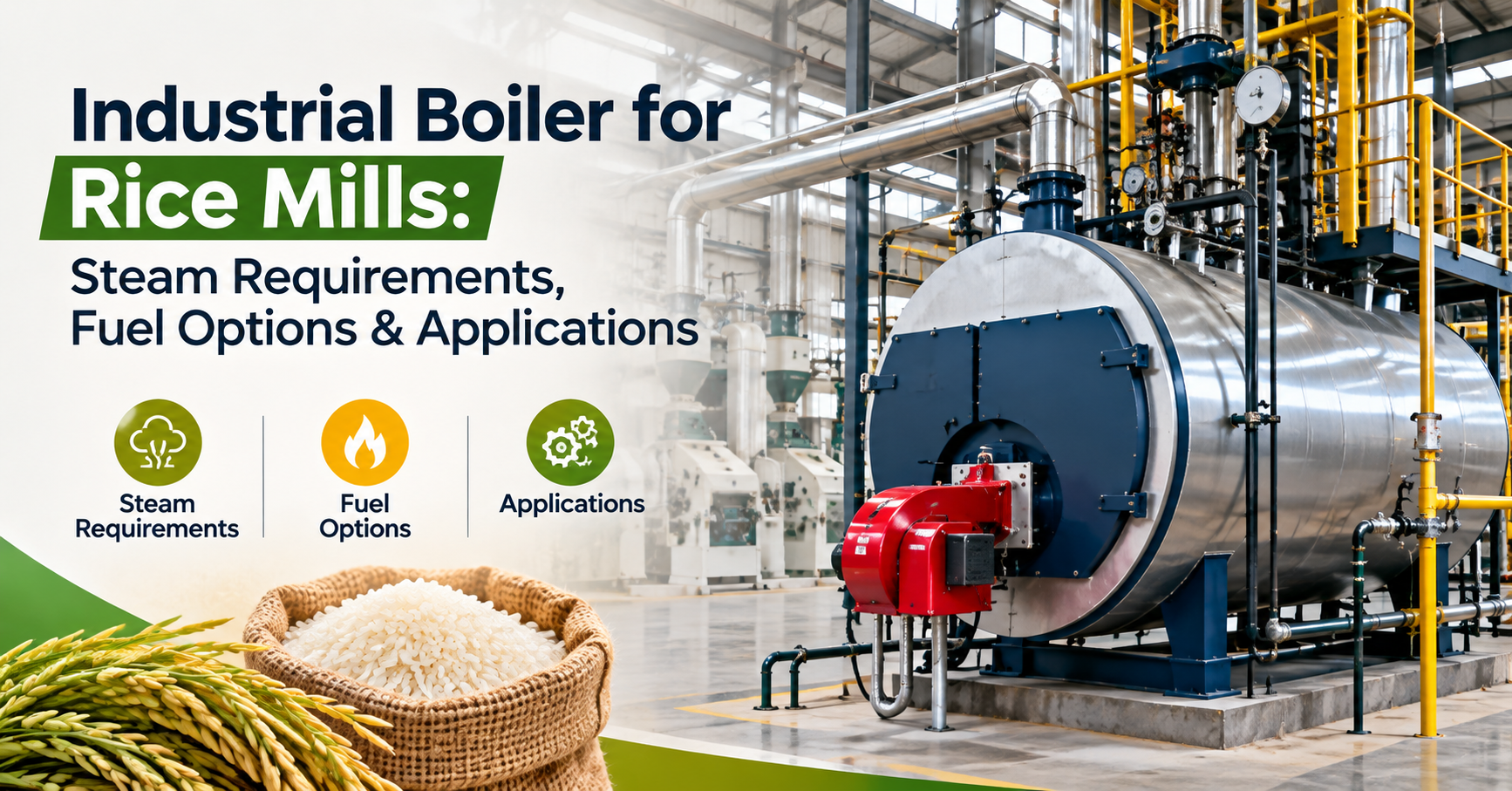
Rice mills require a reliable source of steam and heat for processes such as parboiling, drying and other thermal operations. An appropriately designed industrial boiler for rice mills can provide consistent steam while allowing the mill to make better use of available fuels, including rice husk and other biomass fuels.
For many rice-processing facilities, boiler selection depends on more than steam output. Factors such as required steam pressure, operating hours, fuel availability, rice husk characteristics, boiler efficiency, process load and emissions requirements all influence the right system.
This guide explains rice mill steam requirements, boiler capacity, fuel options, applications and key factors to consider when selecting an industrial boiler for a rice mill.
What Type of Boiler Is Used in a Rice Mill?
A rice mill boiler is an industrial steam-generating system designed to provide the steam and thermal energy required by rice-processing operations.
Rice mills commonly use biomass-fired systems where rice husk is available as a fuel. The Bureau of Energy Efficiency notes that rice husk is commonly used as boiler fuel in rice mills, with steam primarily supporting processes such as parboiling and drying.
Depending on the plant's requirements, an industrial boiler for rice mills may be designed for:
Rice husk
Other agricultural biomass
Wood-based biomass
Biomass pellets
Coal
Oil
Natural gas
Dual-fuel operation
The appropriate boiler should be selected based on the available fuel, required steam output, operating pressure, process demand and site conditions.
For plants requiring an integrated approach to steam generation and industrial energy management, Process Heat & Power Solutions can form part of a broader process-energy strategy.
How Is Steam Used in Rice Mills?
Steam is particularly important in rice processing where controlled heat is required.
1. Parboiling
Parboiling is one of the major applications for steam in rice mills. Steam provides the heat required during the soaking and steaming stages of parboiled rice production.
A consistent steam supply helps maintain stable process conditions and production quality.
2. Drying
Rice drying requires controlled and reliable thermal energy to reduce moisture to the desired level.
Depending on the plant configuration, steam can provide indirect heat for dryers or support associated thermal systems.
3. Rice Processing and Conditioning
Steam and hot thermal energy may also be used for conditioning and other process requirements depending on the rice mill's production configuration.
This makes reliable steam generation for rice mills an important part of overall plant operation.
What Are the Steam Requirements of a Rice Mill?
The rice mill steam requirements depend on several factors rather than simply the quantity of paddy processed.
Important factors include:
Paddy processing capacity
Parboiling method
Number and size of parboiling vessels
Dryer capacity
Steam pressure requirements
Operating hours
Batch cycle
Simultaneous steam demand
Heat losses
Condensate recovery
Therefore, there is no single boiler capacity suitable for every rice mill.
For example, the Bureau of Energy Efficiency reports rice-husk-fired boiler capacities ranging from approximately 0.75 to 12 tonnes of steam per hour across the rice-mill cluster it studied.
The actual requirement should be established through a process-level steam-load assessment.
How to Calculate Boiler Capacity for a Rice Mill
Boiler capacity for a rice mill should be determined from the actual peak and average steam demand.
A simplified assessment can consider:
Total Steam Requirement = Parboiling Steam Demand + Drying/Process Steam Demand + Distribution Losses + Operating Margin
The calculation should consider which equipment operates simultaneously.
For example, if a mill has multiple parboiling units operating at the same time, the boiler must be capable of meeting the combined steam demand rather than simply the demand of one unit.
An undersized boiler can cause:
Insufficient steam pressure
Production interruptions
Longer processing cycles
Poor process control
Increased operating stress
An oversized boiler, on the other hand, may result in inefficient operation when the plant operates substantially below its rated load.
The best approach is therefore to size the boiler around the actual process load and operating profile.
Rice Mill Boiler Fuel Options
Fuel selection is one of the most important decisions when designing an industrial boiler for rice mills.
Rice Husk Fired Boiler
A rice husk fired boiler is a natural option for rice mills because husk is generated as a by-product of the milling process.
Using rice husk for steam generation can allow a mill to convert an internally generated biomass residue into useful process energy. However, boiler design needs to account for the fuel's characteristics, including moisture, ash content, particle size, feeding behaviour and combustion properties.
Rice-husk-specific boiler designs are available across different capacities and configurations.
Biomass Boiler
A biomass boiler for rice mills can be designed to operate with rice husk and, where technically suitable, other biomass fuels.
Potential biomass fuels include:
Rice husk
Wood chips
Sawdust
Agricultural residues
Biomass pellets
Other suitable agro-waste
The ability to use multiple fuels can be useful where rice husk availability changes seasonally or where supplementary biomass is available.
Oil and Gas-Fired Boilers
Oil, natural gas and other gaseous or liquid fuels can also be used where biomass is unavailable or where the plant requires a different fuel configuration.
These options may provide operational flexibility but their suitability depends on fuel availability, energy costs, infrastructure and applicable environmental requirements.
Why Is Rice Husk a Useful Boiler Fuel?
For rice mills, rice husk offers an important operational advantage: it is generated during the milling process itself.
Instead of treating husk solely as a waste or by-product, the mill can potentially use it as fuel for steam generation.
However, rice husk is not a generic fuel that can be treated identically to every other biomass. Its ash and fuel-handling characteristics need to be considered when designing the combustion system.
The fuel should therefore be evaluated before finalising the boiler design.
What Are the Main Applications of an Industrial Boiler in a Rice Mill?
The primary industrial boiler applications in rice mills include:
Parboiling
Steam is supplied to parboiling equipment to provide controlled thermal energy during rice processing.
Drying
Boiler-generated steam can support indirect heating systems used for drying, depending on the dryer configuration.
Process Heating
Steam may be distributed to other equipment requiring thermal energy.
Integrated Energy Systems
Where steam pressure and demand conditions are suitable, a rice mill may also evaluate opportunities for recovering energy from steam systems.
For example, high-pressure steam can potentially be expanded through a back-pressure steam turbine before being supplied to a lower-pressure process. This can create an opportunity for combined steam and power utilisation.
Daack Vessels provides Packaging Steam Turbines for industrial applications including captive power generation, cogeneration and steam energy recovery.
How to Improve Rice Mill Boiler Efficiency
Installing the right boiler is only the first step. Operating practices also influence energy performance.
Important measures include:
Maintain the Correct Fuel-Air Ratio
Excess air can increase heat losses through the flue gas. Combustion should therefore be properly controlled according to the selected fuel and boiler design.
Recover Waste Heat
Heat from boiler flue gases can potentially be recovered using appropriate heat-recovery equipment.
Improve Insulation
Proper insulation of boilers, steam pipelines, valves and other hot surfaces can reduce avoidable heat losses.
Recover Condensate
Returning suitable condensate to the boiler system can reduce the energy required to heat feedwater.
Maintain Heat-Transfer Surfaces
Deposits and fouling can reduce heat transfer and increase fuel consumption. Regular inspection and maintenance are therefore important.
The Bureau of Energy Efficiency has identified issues such as excessive combustion air, inadequate insulation, lack of condensate-pipeline insulation and non-recovery of boiler flue-gas heat as energy-loss opportunities in rice-mill boiler systems.
How to Select an Industrial Boiler for a Rice Mill
Before choosing a steam boiler for a rice mill, evaluate the following:
Steam output: Determine peak and average steam demand.
Operating pressure: Identify the pressure required by the parboiling and drying systems.
Fuel: Assess rice husk availability, moisture, ash and other fuel characteristics.
Operating hours: Continuous and high-hour operation may require a different configuration from intermittent operation.
Boiler efficiency: Compare expected performance under actual operating conditions.
Fuel handling: Consider storage, feeding and ash removal requirements.
Emissions: Evaluate applicable emission-control and regulatory requirements.
Maintenance: Consider accessibility and availability of critical components.
Future expansion: Allow for realistic increases in production and steam demand.
System integration: Consider condensate recovery, heat recovery and other process-energy systems.
A technical assessment based on actual mill data is preferable to selecting a boiler solely from the mill's nominal production capacity.
Industrial Boiler for Rice Mills: Why Correct Sizing Matters
The right industrial boiler for rice mills should match the plant's actual steam demand and fuel characteristics.
A boiler that is too small may struggle to maintain the required steam pressure during peak production. A boiler that is too large may spend significant periods operating at low load.
Correct sizing helps balance:
Steam demand + pressure requirements + fuel availability + operating profile + efficiency + future capacity
For this reason, boiler selection should begin with the process rather than with a particular boiler model.
Frequently Asked Questions
What type of boiler is used in a rice mill?
Rice mills commonly use industrial steam boilers, including biomass-fired systems designed to use rice husk where it is available. The exact boiler configuration depends on steam demand, pressure, fuel characteristics and plant capacity.
What fuel is used in rice mill boilers?
Rice husk is a common fuel option because it is generated as a by-product of rice milling. Other biomass fuels, coal, oil or gas may also be considered depending on availability, boiler design and site requirements.
Can rice husk be used as boiler fuel?
Yes. Rice husk can be used as boiler fuel when the combustion and fuel-handling system is specifically designed or appropriately configured for its characteristics.
What is the steam requirement of a rice mill?
Steam requirements vary according to paddy throughput, parboiling equipment, dryer capacity, operating schedule, steam pressure and simultaneous process loads. A process-level assessment is required to determine the appropriate boiler capacity.
How do you select a boiler for a rice mill?
Start by assessing steam demand, required pressure, fuel characteristics, operating hours, fuel-handling requirements, emissions requirements and future expansion plans. The boiler should then be selected based on the complete process requirement.
What are the main applications of steam in rice mills?
The main applications include parboiling, drying and other process-heating requirements. Steam may also form part of an integrated energy system where power recovery or other heat-recovery opportunities are technically suitable.
Conclusion
An industrial boiler for rice mills is a critical part of a reliable rice-processing operation. The right system must provide adequate steam for parboiling, drying and other process requirements while matching the mill's fuel availability and operating conditions.
For many rice mills, rice husk fired boilers and biomass boilers can provide an opportunity to convert an available agricultural by-product into useful process energy. However, fuel characteristics, steam demand, boiler capacity, pressure, emissions and system integration should all be considered before selecting the equipment.
A properly engineered boiler system can help rice mills achieve reliable steam generation, better fuel utilisation and improved overall energy performance.
For rice mills evaluating complete industrial steam and energy systems, Industrial Boiler Manufacturers in India can be considered as part of the broader evaluation of boiler and process-energy solutions.